 World of Shrimp
Shrimp tank maintenance: a simple routine
Published · Updated · 5 min read
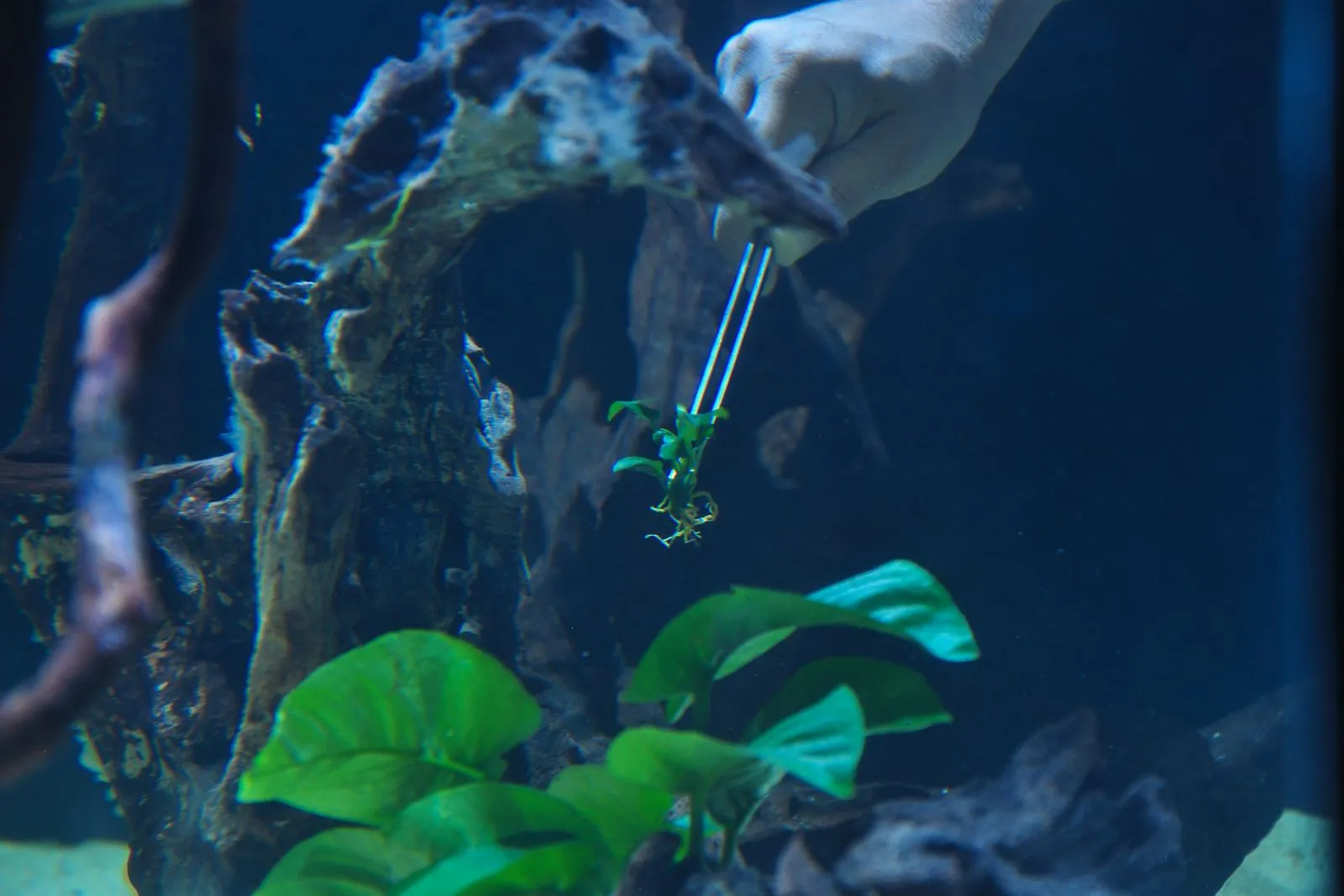
Quick answer
- Every day: a quick look at the shrimp, the thermometer and the filter.
- Every week or two: test nitrate, top up evaporated water, and change about 10 to 20 percent of the water.
- Every one to three months: squeeze the sponge filter in old tank water when the flow slows.
- Leave some algae and biofilm in the tank. Shrimp eat it.
- Small, regular care is safer for shrimp than a rare, big clean-up.
Why a routine matters
Shrimp cope well with steady water and badly with sudden change. A big clean-up changes the temperature, hardness and TDS (total dissolved solids, everything dissolved in the water) all at once. Shrimp and Snail Breeder warns that big water changes can cause molting problems. Shrimp Science recommends a steady schedule instead of waiting until the water gets bad, and warns against changing water too often.
So the aim is a light, regular routine. Most of it takes a few minutes.
The routine at a glance
| How often | Task | Why |
|---|---|---|
| Every day | Look at the shrimp, check the thermometer and the filter, feed a small amount | Spot problems early |
| Every week | Test nitrate, top up evaporated water, remove dead leaves | Nitrate builds up, and evaporation concentrates minerals |
| Every 1 to 2 weeks | Change about 10 to 20 percent of the water | Keeps nitrate under about 20 ppm |
| Every few weeks | Test GH, KH, pH and TDS | Catches slow drifts |
| Every 1 to 3 months | Squeeze the sponge filter in old tank water when the flow slows | Keeps water moving without losing bacteria |
| Every 12 to 18 months | Plan to replace active soil, if you use it | It slowly stops buffering |
Every day
- Watch the shrimp for a minute. Grazing and exploring are normal, and so is some hiding. Shrimp Science lists constant swimming, one shrimp lying still for hours, and many shrimp gathering at the surface as warning signs.
- Remove dead shrimp so they do not rot. An empty, see-through shell is usually a molt, not a dead shrimp, and can stay in the tank. See molting.
- Check the thermometer and that the filter is still bubbling.
- Feed a small amount. Give only what they finish in about 2 to 3 hours, then remove the rest. See feeding.
Every week or two
- Test nitrate. Nitrate is the end product of the nitrogen cycle. If it is above about 20 ppm (parts per million), it is time for a water change. Aquarium Co-Op says to change water at 40 ppm or more at the latest.
- Top up evaporated water with RO or distilled water. Evaporation removes water but leaves the minerals behind, so topping up with tap water slowly raises TDS.
- Change about 10 to 20 percent of the water. Shrimp Science suggests starting with about 10 percent every two weeks. Shrimp and Snail Breeder suggests about 20 percent a month for most keepers, split into smaller changes if you like. Cover the siphon with fine mesh so baby shrimp stay in the tank. The water change guide has the full method.
- Remove dead or melting plant leaves, and wipe the front glass if you cannot see in.
Every one to three months
- Clean the sponge filter when the flow slows. Aquarium Co-Op suggests about once a month, and Shrimp Science every couple of months. Squeeze it in old tank water, never under the tap. See sponge filters.
- Test GH, KH, pH and TDS. GH (general hardness) is the calcium and magnesium shrimp need for their shells. KH (carbonate hardness) keeps pH steady. Shrimp Science notes that a slowly rising GH can mean your new water has too much calcium.
- Vacuum the substrate lightly during a water change, if waste builds up.
Write your test results down with the date. A small notebook makes slow changes, like TDS creeping up, easy to see.
When to do more
The routine is a baseline. Shrimp Science suggests doing water changes more often if you see failed molts, nitrate that keeps climbing, or water that looks dirty. If several shrimp die within a few days, test ammonia, nitrite and nitrate straight away and do a small water change with well-matched water. The guide to why shrimp die lists what else to check.
What to leave alone
- Biofilm and soft algae. This thin coat on surfaces is the main food of shrimp. Leave most of it.
- Some mulm. The fine brown waste on the bottom is partly food. Only remove it when it piles up.
- The filter between cleanings. Cleaning it too often or too well removes the bacteria that break down waste.
- Untested products. Do not add medicines or fertilizers you have not checked. Some contain copper, which is toxic to shrimp.
FAQ
How often should I clean a shrimp tank?
Little and often. A quick look every day, a small water change every one to two weeks and a filter squeeze every one to three months is enough for most tanks. Shrimp eat biofilm and algae, so a spotless tank is not the goal.
Should I remove algae from a shrimp tank?
Only some. Shrimp graze on soft algae and biofilm, so leave some for them. Wipe the front glass if you cannot see in, and remove algae that smothers plants.
What should I test in a shrimp tank, and how often?
In an established tank, test nitrate about once a week or before each water change, and GH, KH, pH and TDS every few weeks. In a new tank, or when shrimp die, test ammonia and nitrite as well.
Sources
- Shrimp Science: Shrimp Tank Water Changes
- Shrimp Science: How to Clean a Sponge Filter
- Shrimp Science: Signs of Stress in Freshwater Shrimp
- Shrimp and Snail Breeder: How to Do and How Often to Do Water Change in Shrimp Aquarium
- Aquarium Co-Op: The Beginner's Guide to the Nitrogen Cycle for Aquariums
- Aquarium Co-Op: Sponge Filters: The Easiest Fish Tank Filter Ever
- Shrimp Science: The Guide to Substrates for Shrimp Tanks
Keep reading
-
 How to do a water change in a shrimp tank
How much water to change, how often, and how to do it without stressing your shrimp.
-
 Sponge filters for shrimp tanks: how they work and how to clean them
Why shrimp keepers use sponge filters, how to set one up and how to clean it safely.
-
 What and how often to feed shrimp
What shrimp eat, how much to give them and how to avoid overfeeding.