 World of Shrimp
Cherry shrimp tank mates: what can live with them?
Published · Updated · 5 min read
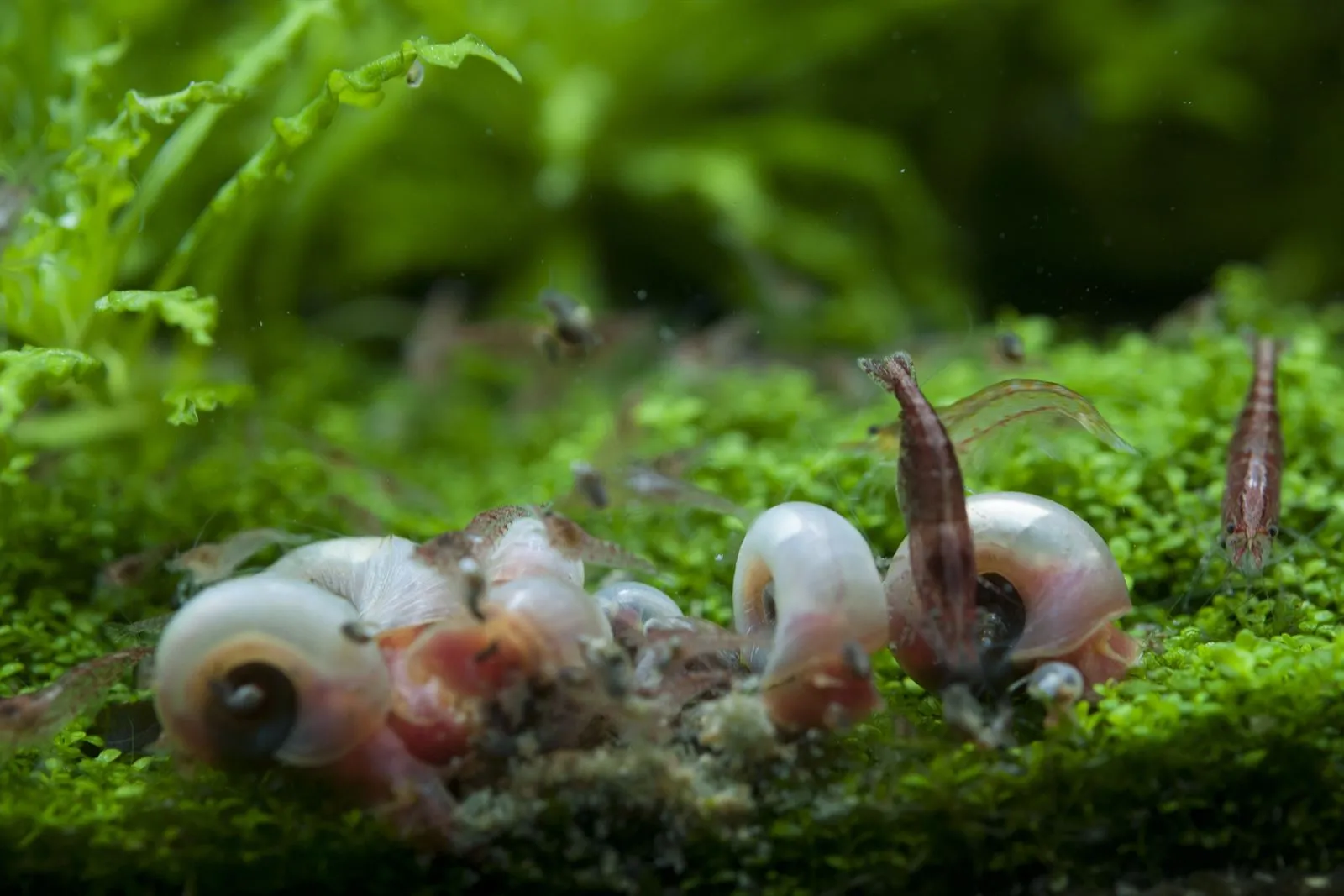
Quick answer
The safest tank mates for cherry shrimp are snails and peaceful shrimp such as Amano shrimp. Some small, peaceful fish leave adult shrimp alone, but almost all fish eat baby shrimp. Avoid bettas, cichlids, goldfish, crayfish and other large or predatory animals. If you want your colony to grow, keep shrimp on their own or with a few snails.
Why shrimp-only is best for breeding
Cherry shrimp are small. Adults are about 2.5 to 4 cm long, and newborn babies are only about 2 mm. Almost all fish will eat baby shrimp, and even fish sold as "shrimp-safe" usually eat some.
So if you want a colony that grows, the simplest choice is a shrimp-only tank, perhaps with a few snails. Shrimp sellers and care guides agree on this.
A shrimp-only tank also keeps things simple. There are no fish to feed separately, no fish medicines that may contain copper, and less waste in a small tank.
Tank mates at a glance
| Tank mate | Adult shrimp | Baby shrimp |
|---|---|---|
| Nerite, ramshorn, bladder, mystery and Malaysian trumpet snails | Safe | Safe, but they compete for food |
| Amano shrimp | Safe | Not listed as a risk |
| Otocinclus, pygmy corydoras | Usually safe | May eat some |
| Ember tetras, chili rasboras, small rasboras | Usually safe | Will eat them |
| Guppies, Endler's livebearers | Usually safe | Will eat them; needs dense plants |
| Betta | Risky, depends on the fish | Will eat them |
| Dwarf cichlids, dwarf gouramis, pea puffers | Risky | Will eat them |
| Goldfish, cichlids, larger fish, crayfish, large prawns | Will eat them | Will eat them |
"Usually safe" means guides list these fish as leaving adult shrimp alone. It is not a guarantee. Every fish is an individual.
Snails and other shrimp
Common aquarium snails, such as nerite, ramshorn, bladder, mystery and Malaysian trumpet snails, are scavengers. They eat leftovers and algae, not living shrimp. They do eat the same food as shrimp, so a very large snail population can mean fewer baby shrimp survive. They also help by eating leftover food that would otherwise rot. If snails suddenly multiply, it is usually a sign of overfeeding.
Amano shrimp are one of the most common companions for cherry shrimp. They are bigger and peaceful, and the two usually live together without problems.
Caridina shrimp, such as crystal red and bee shrimp, are a different story. They need softer, more acidic water, around pH 5.5 to 6.5, so in a shared tank one of the two groups is always outside its comfort zone. Keep them in separate tanks.
Small fish
Some small, peaceful fish usually leave adult cherry shrimp alone. Fish often listed by shrimp sellers and care guides include otocinclus, pygmy corydoras, ember tetras, chili rasboras, guppies and Endler's livebearers.
But none of this is guaranteed. Every fish has its own personality, and most fish will still eat baby shrimp when they find them. With fish in the tank, expect a slower-growing colony, or one that does not grow at all.
Animals to avoid
- Bettas. Some live peacefully with shrimp, others hunt them. It depends on the individual fish, so it is a gamble.
- Dwarf cichlids, dwarf gouramis and pea puffers. Guides warn against them as predators of small animals.
- Goldfish, cichlids and larger fish. Shrimp are a snack for them.
- Crayfish, large prawns and long-arm shrimp. They eat smaller shrimp.
- Fast, hungry fish such as zebra danios. They chase shrimp and take their food.
Mixing cherry shrimp colors
Red, blue, yellow, orange and other cherry shrimp colors are all the same species, Neocaridina davidi. They get along fine and can interbreed.
Their babies are usually not a mix of the two colors. Over a few generations, they tend to turn back toward the wild color: see-through with brown spots. That is fine if you like a mixed "wild" colony. If you want to keep bright colors, keep one color per tank.
Tips if you add fish
- Give the shrimp lots of cover: moss, dense plants, rock piles or shrimp caves.
- Keep the fish well fed, so they are less interested in shrimp.
- Expect fewer baby shrimp to survive.
- Treat sick fish in a separate tank. Many fish medicines contain copper, which is toxic to shrimp.
- Quarantine new fish, snails and plants before they go in. They can carry pests such as hydra and planaria, and some plants are treated with snail killers that contain copper.
Planning a new tank? Our guide on how to set up a 20-liter shrimp tank starts from the beginning.
FAQ
Can cherry shrimp live with a betta?
Sometimes, but it is a gamble. Some bettas ignore shrimp and others hunt them, and almost all will eat babies. If you try it, use a densely planted tank with lots of moss and expect to lose some shrimp.
Can different colors of cherry shrimp live together?
Yes, they get along fine, but they interbreed. Their babies usually lose the bright colors over a few generations and turn back toward a brownish wild color. Keep one color per tank if you want to keep the colors strong.
Can cherry shrimp live with Amano shrimp?
Yes. Amano shrimp are one of the most common tank mates for cherry shrimp, and the two usually live together peacefully.
Will snails eat my shrimp?
Common aquarium snails such as nerite, ramshorn, bladder, mystery and Malaysian trumpet snails are scavengers and won't eat living shrimp. They do eat the same food, so a big snail population can mean fewer baby shrimp survive.
Sources
- Aquarium Co-Op: Top 12 Tank Mates to Keep With Cherry Shrimp
- Aquarium Co-Op: Care Guide for Cherry Shrimp
- The Shrimp Farm: Shrimp Tankmates and Compatibility
- The Shrimp Farm: Yellow Shrimp Tank Set-Up and Care
- Shrimp Science: Red Cherry Shrimp care guide
- Shrimp Science: Neocaridina davidi
- Shrimp Science: The Guide to Substrates for Shrimp Tanks
- Shrimp Science: Why Are My Freshwater Shrimp Dying?
- Shrimp and Snail Breeder: Red Cherry Shrimp: Care, Diet and Breeding
- Shrimp and Snail Breeder: Shrimp Feeding Guide: How Much, How Often, and When to Stop
- Shrimp and Snail Breeder: How Copper Affects Dwarf Shrimp
- Shrimp and Snail Breeder: Planaria and Shrimps: How to Remove Them
- Shrimp Science: What Do Freshwater Shrimp Eat?
Keep reading
-
 How to set up a 20-liter shrimp tank
Equipment, substrate, plants, water and cycling, in the order you need them.
-
 Cherry shrimp breeding: males, females and berried shrimp
How to tell males from females, what berried means and how to raise the babies.
-
 Why are my shrimp dying? 8 common causes and what to check
The usual reasons shrimp die, and what to test first.